Hannah Keeley–Mary Keeley mother-daughter relationship
Crazy Mama: 9 Steps to a Not-So-Normal LifeHannah Keeley’s relationship with her mother, Mary Keeley, is presented through vivid memories of childhood misfit and later family storytelling. Mary tries dance and music lessons in hopes of finding activities that suit her daughter, and Hannah’s father intervenes when school plans to place her in special-needs classes. The eventual discovery that Hannah qualifies for advanced studies gives the family’s efforts a striking reversal: the problem was not an absence of ability, but that no one had yet found a way to recognize it. In a later anecdote, Mary’s carefully preserved bread-pudding recipe becomes another point of connection, carrying family knowledge beyond the home and into the church community.
Childhood and Attempts to Find a Fit
Hannah recalls that she was already conspicuous among her peers: in fourth grade she stood five and a half feet tall, and a family video from a kindergarten picnic shows her as the unusually tall child in line, facing backward. The image is comic in her telling, but it also establishes the difficulty of blending in that shaped her early experience. Her mother’s response was to try organized activities that might give Hannah a place to belong or a way to develop her abilities.
Mary enrolled her in a dance class, but Hannah did not even understand that the activity was a dance lesson. To her, Mary had dressed her in a tutu and sent her into a room to jump around for an hour. After about a month, the teacher recommended transferring her to a class with more personalized attention, and Mary withdrew her. The episode captures a mismatch between the intended lesson and Hannah’s understanding of it; its humor does not obscure that Mary was actively seeking an approach that might work.
Music lessons produced a similarly chaotic sequence. Hannah remembers the black clarinet, its shiny buttons, and licking the wooden mouthpiece, but little else of the instruction. Mary then moved her to violin. By the fourth lesson, Hannah was using the horsehair bow to bang piano keys and shouting that she could not learn the instrument. That lesson was her last. In these recollections, Mary’s efforts are tangible and varied, while Hannah’s resistance and distraction are part of the same family story rather than evidence of a simple lack of care.
School Crisis and Reassessment
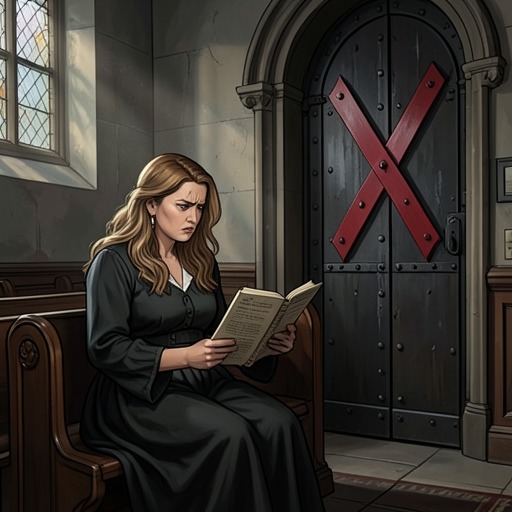
As Hannah entered middle school, desks, lectures, and books left her mind wandering. Notes repeatedly came home for her parents to sign, usually reporting that she did not pay attention; one reported that she had started a cafeteria food fight. A sealed envelope eventually brought a more consequential judgment: the school proposed placing her in special-needs classes. Hannah remembers delaying before handing it to her parents, anticipating their response with anxiety.
The imagined scene in which her father storms the school, tears up records, and rescues her is explicitly distinguished from what actually happened. Mary’s part in that moment appears through Hannah’s account of her mother remembering the earlier tutus and ballet slippers, while her father asked the school to test whether Hannah truly qualified for the placement. The family thus did not simply accept the proposed classification. They sought an assessment, and its result changed Hannah’s educational path: she moved from special-needs classes to advanced studies.
The reassessment was followed by a marked academic improvement. Hannah says her grades rose from Ds and Fs to As and Bs, and that in high school she became one of the top-performing students, graduating around fourth in a class of twenty-seven. Her account credits the discovery of an ability that had not been reached by earlier schooling. Mary’s remembered attempts to find a suitable activity and the parents’ response to the school notice sit within that larger change: a childhood previously narrated through failed lessons and attention problems opens onto newly recognized academic capacity.
Family Memory and Shared Knowledge
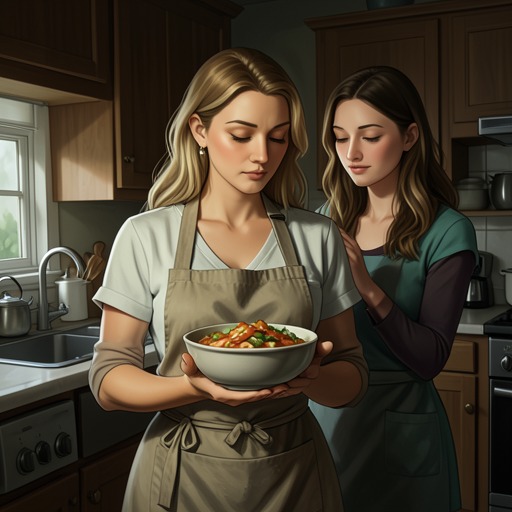
The adult Mary in Hannah’s stories is also associated with a recipe. Mary’s bread pudding is described as a familiar favorite at church luncheons, where the dish is quickly finished and people ask for it. When a church member requests the recipe, Mary writes it on the back of a church bulletin from memory and asks to hear how it turns out. The episode presents her expertise as practical and generously shared, not guarded as a private possession.
When the caller later explains that she substituted margarine for butter and bottled lemon juice for freshly squeezed lemons, Hannah’s mother responds that she thinks she knows what went wrong. The exchange makes the recipe a small but precise record of how family knowledge is transmitted: Mary can reproduce her instructions from memory, while Hannah witnesses both the confidence behind them and the importance of following them. The story does not describe a major confrontation or a formal lesson between mother and daughter; instead, their connection appears in the ease with which Hannah tells a family anecdote and in her attention to what Mary knows.
Meaning of the Relationship in Hannah’s Narrative
Hannah’s memories combine affectionate humor with episodes in which adults try to interpret her abilities. The dance teacher’s recommendation, the abandoned instruments, the school’s proposed placement, and the later testing are distinct moments, but together they show how easily unusual behavior and difficulty concentrating could be mistaken for a limit on what she might learn. Mary is present in this history as the mother who arranged activities and whose memories of those attempts accompany the school crisis; the account does not claim that she alone produced Hannah’s academic turnaround.
The relationship is also situated in Hannah’s broader attention to family life as a place where skill, care, and character become visible. Her stories of motherhood elsewhere in the book concern managing children and household demands, while the memories of Mary show her looking back from the daughter’s position. The two perspectives are not identical, but the contrast gives the maternal bond texture: Hannah can joke about the tutu, the clarinet, and the piano keys while also recording the consequential discovery that she could thrive academically. Mary’s remembered efforts and her bread-pudding expertise thus belong to the same portrait of a family relationship told through ordinary acts, imperfect attempts, and stories that remain worth retelling.